

BLOG
Forget Cowbells. Cows Wear High-Tech Collars Now.
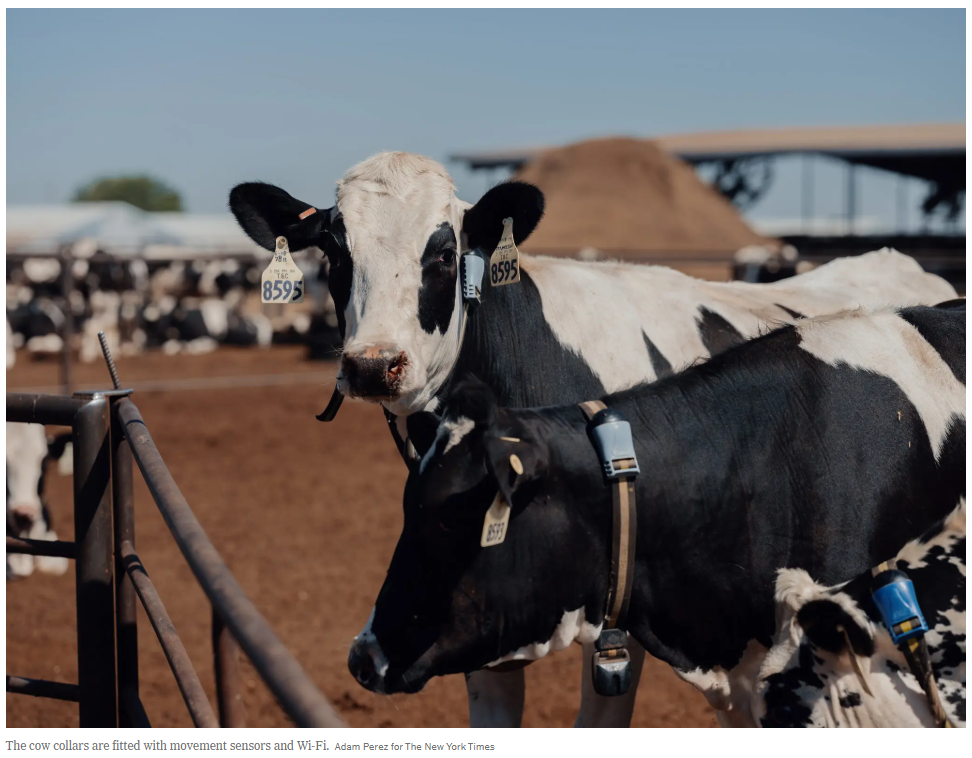
“The cow at the edge of Tony Louters’s dairy farm in Merced, Calif., held 11 gallons of milk and a secret: In the next 48 hours, she would become sick.”
“On many farms, the health signs would have gone undetected, costing hundreds of dollars in lost milk. But thanks to a high-tech collar that each of Mr. Louters’s 700 cows wears around its neck — fitted with movement sensors and Wi-Fi — he learned the cow’s diagnosis at 5:30 a.m. when his computer pinged with an alert about its biometric data.”
“Mr. Louters, 52, has used the collars since they debuted in 2013, back when the devices were no more advanced than a pedometer. But in recent years, Merck, the health care company that makes the collars, has added new kinds of sensors and software to the wearables and artificial intelligence to help process the data.”
“The devices are part of an industry known as precision farming, a data-driven approach for optimizing production that is booming with the addition of A.I. and other technologies. Last year, the livestock-monitoring industry alone was valued at more than $5 billion, according to Grand View Research, a market research firm.”
“Farmers have long used technology to collect and analyze data, with the origins of precision farming dating to the 1990s. In the early 2000s, satellite imagery changed the way farmers determined crop schedules, as did drones and eventually sensors in the fields. Nowadays, if you drive by farms in places like California’s Central Valley, you may not see any humans at all.”
We Can Now Track Individual Monarch Butterflies. It’s a Revelation.

“Scientists used tiny new sensors to follow the insects on journeys that take thousands of miles to their winter colonies in Mexico.”
“For the first time, scientists are tracking the migration of monarch butterflies across much of North America, actively monitoring individual insects on journeys from as far away as Ontario all the way to their overwintering colonies in central Mexico.”
“This long-sought achievement could provide crucial insights into the poorly understood life cycles of hundreds of species of butterflies, bees and other flying insects at a time when many are in steep decline.”
“The breakthrough is the result of a tiny solar-powered radio tag that weighs just 60 milligrams and sells for $200. Researchers have tagged more than 400 monarchs this year and are now following their journeys on a cellphone app created by the New Jersey-based company that makes the tags, Cellular Tracking Technologies.”
“Tracking the world’s most famous insect migration may also have a big social impact, with monarch lovers able to follow the progress of individual butterflies on the free app, called Project Monarch Science. Many of the butterflies are flying over cities and suburbs where pollinator gardens are increasingly popular. Some tracks could even lead to the discovery of new winter hideaways.”
“A crucial engineering feat led to the tracking breakthrough. Earlier this year, Cellular Tracking Technologies modified its butterfly tag, which it calls BlūMorpho, in a way that allows its signals to be automatically detected by billions of Bluetooth-enabled devices, as long as a tagged butterfly passes within about 300 feet.”
China’s transparent coating to turn ordinary windows into solar power generators
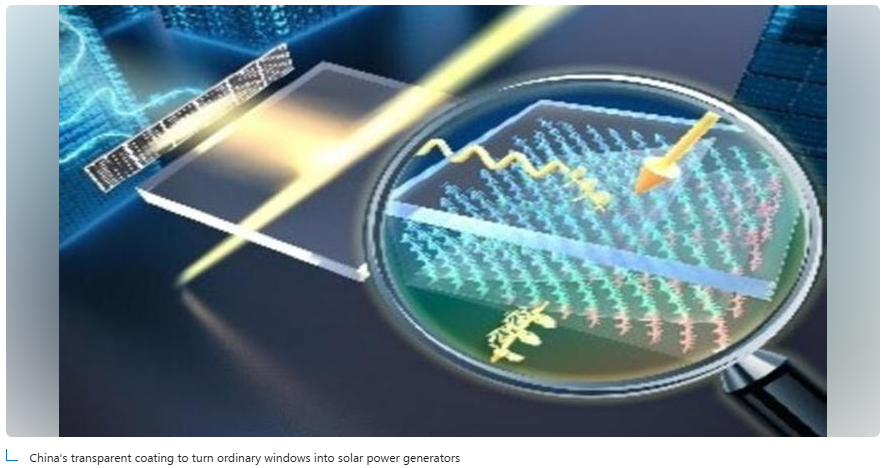
“Researchers in China have created a transparent, colorless, and unidirectional solar concentrator that can be directly coated onto standard window glass and used to harvest sunlight without changing the window’s appearance.”
“According to the scientists, this unique diffractive-type solar concentrator (CUSC) selectively guides sunlight toward the edge of the window where photovoltaic (PV) cells are installed.”
“These optical qualities mean the coating can generate clean energy while keeping the glass clear and natural-looking, and ensure that windows remain visually indistinguishable from ordinary glass.”
“‘The CUSC design is a step forward in integrating solar technology into the built environment without sacrificing aesthetics,’ Wei Hu, PhD, a computer science and technology professor at Nanjing University and corresponding author, said.”
French Government Uses AI to Spot Undeclared Swimming Pools — And Tax Them, by James Vincent

“The French government has collected nearly €10 million in additional taxes after using machine learning to spot undeclared swimming pools in aerial photos. In France, housing taxes are calculated based on a property’s rental value, so homeowners who don’t declare swimming pools are potentially avoiding hundreds of euros in additional payments.”
“The project to spot the undeclared pools began last October, with IT firm Capgemini working with Google to analyze publicly available aerial photos taken by France’s National Institute of Geographic and Forest Information. Software was developed to identify pools, with this information then cross-referenced with national tax and property registries.”
“The project is somewhat limited in scope, and has so far analyzed photos covering only nine of France’s 96 metropolitan departments. But even in these areas, officials discovered 20,356 undeclared pools, according to an announcement this week from France’s tax office, the General Directorate of Public Finance (DGFiP), first reported by Le Parisien.”
“As of 2020, it was estimated that France had around 3.2 million private swimming pools, but constructions have reportedly surged as more people worked from home during COVID-19 lockdowns, and summer temperatures have soared across Europe.”
“Ownership of private pools has become somewhat contentious in France this year, as the country has suffered from a historic drought that has emptied rivers of water. An MP for the French Green party (Europe Écologie les Verts) made headlines after refusing to rule out a ban on the construction of new private pools. The MP, Julien Bayou, said such a ban could be used as a ‘last resort’ response. He later clarified his remarks on Twitter, saying: ‘[T]here are ALREADY restrictions on water use, for washing cars and sometimes for filling swimming pools. The challenge is not to ban swimming pools, it is to guarantee our vital water needs.”’
How People Adapt to Cybersickness From Virtual Reality, by Rachel Cramer – Iowa State University
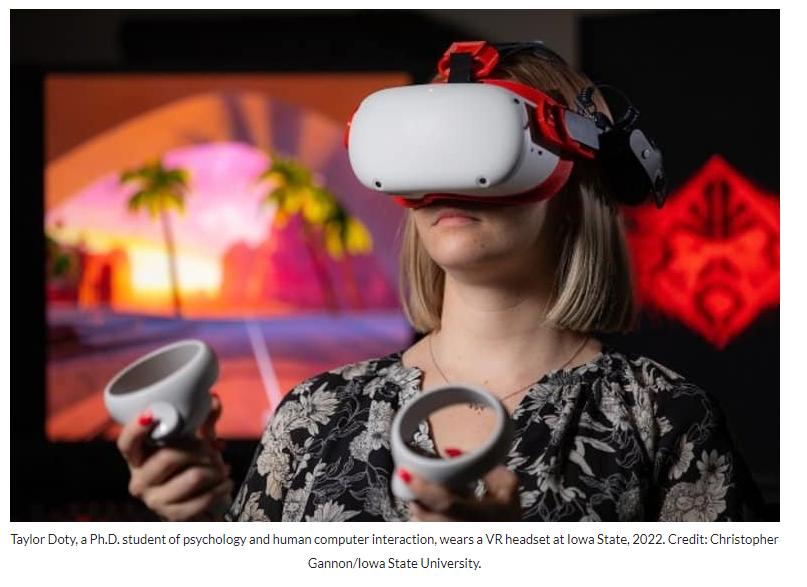
“While virtual reality has been around for decades, a combination of higher-resolution graphics, smoother tracking of the user’s movements and cheaper, sleeker headsets has propelled the immersive technology into arenas beyond gaming and military training.”
“In health care, VR has been used to prepare surgeons for complicated operations and help burn patients better manage their pain. In education, it’s opened doors for students to tour world famous museums, historical sites – even the human brain.”
“But Jonathan Kelly, a professor of psychology and human computer interaction at Iowa State University, says the biggest barrier to VR becoming mainstream is cybersickness. Previous studies show more than half of first-time headset users experience the phenomenon within 10 minutes of being exposed to VR.”
“Many of the symptoms – nausea, dizziness, headaches, eye fatigue, sweating and a lingering sense of movement – overlap with other forms of motion sickness. Kelly explained they’re all caused by conflicting sensory information.”
“‘When someone reads a book in a moving car, their eyes recognize a stationary environment while parts of the inner ear and brain that are involved in balance and spatial orientation pick up accelerations, turns and bumps,’ said Kelly.”
“In a virtual setting, the inverse is true. An individual’s visual system perceives the rush from a roller coaster ride while sitting on a coach. Even without the stomach drop or whiplash, the dissonance can make someone want to hurl.”
Google Adds AI Language Skills to Alphabet’s Helper Robots to Better Understand Humans, by James Vincent
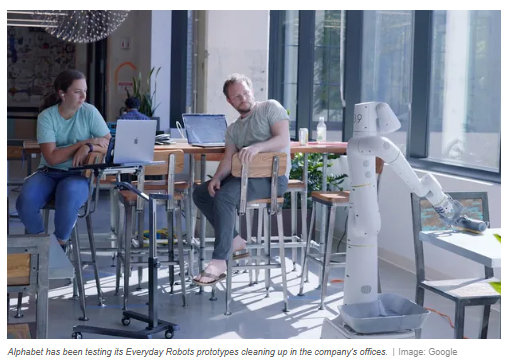
“Google’s parent company Alphabet is bringing together two of its most ambitious research projects — robotics and AI language understanding — in an attempt to make a ‘helper robot’ that can understand natural language commands.”
“Since 2019, Alphabet [has] been developing robots that can carry out simple tasks like fetching drinks and cleaning surfaces. This Everyday Robots project is still in its infancy — the robots are slow and hesitant — but the bots have now been given an upgrade: improved language understanding courtesy of Google’s large language model (LLM) PaLM.”
“Most robots only respond to short and simple instructions, like ‘bring me a bottle of water.’ But LLMs like GPT-3 and Google’s MuM are able to better parse the intent behind more oblique commands. In Google’s example, you might tell one of the Everyday Robots prototypes ‘I spilled my drink, can you help?’ The robot filters this instruction through an internal list of possible actions and interprets it as ‘fetch me the sponge from the kitchen.”’
“Yes, it’s kind of a low bar for an ‘intelligent’ robot, but it’s definitely still an improvement! What would be really smart would be if that robot saw you spill a drink, heard you shout ‘gah oh my god my stupid drink’ and then helped out.”
VR Surgical Training Platform Raises $20M, Further Solidifying VR’s Place in Medicine, by Ben Lang
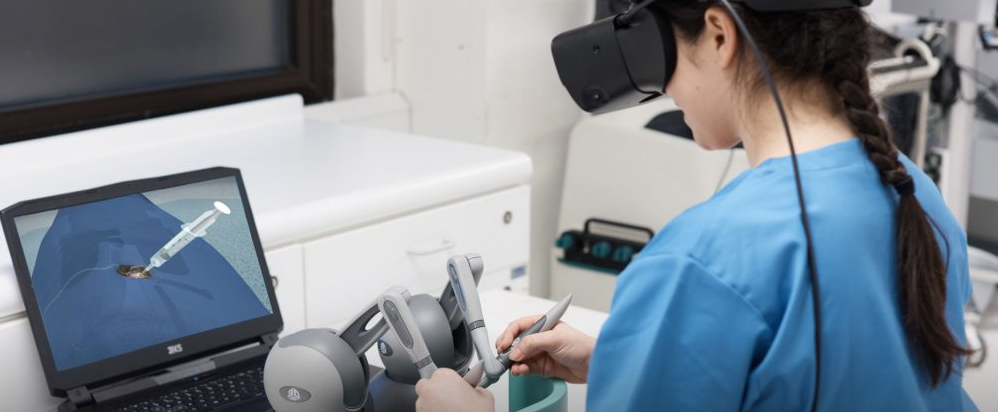
“VR surgical training platform FundamentalVR today announced it has raised a $20 million Series B investment to further expand its VR surgical training platform. The company is among a growing list of companies taking root in what appears to be a prime use-case for VR.”
“FundamentalVR today announced it has raised a $20 million Series B investment, bringing the company’s total fundraising to a purported $30 million. The round was led by EQT Life Sciences and prior investor Downing Ventures. As part of the investment, Drew Burdon of EQT Life Sciences will join FundamentalVR’s Board of Directors.”
“FundamentalVR says it combines high-fidelity medical simulations with VR and haptics so that trainees can ‘experience the sights, sounds, and physical sensations of real-life surgery.’ The goal, says the company, is to make it more affordable for medical institutions to bring ‘professionally accredited surgical training [to] their organizations.”’
“According to FundamentalVR, the investment will be used to ‘enable further development of [the surgical training platform], the machine learning data insights product, and [drive] geographic expansion throughout the US.”’
“‘Our platform can conduct a walkthrough of a procedure through to a full operation, facilitating surgical skills transfer—which is why we have been enthusiastically embraced throughout the medical industry, from med-device manufacturers to pharmaceuticals’ says FundamentalVR CEO Richard Vincent. ‘Our immersive environments transform surgical skills acquisition in a scalable, low-cost, multiuser way. We are excited to scale our vision of creating a medical education environment unhindered by borders.’”
Self-Taught AI Shows Similarities to How the Brain Works, by Anil Ananthaswamy
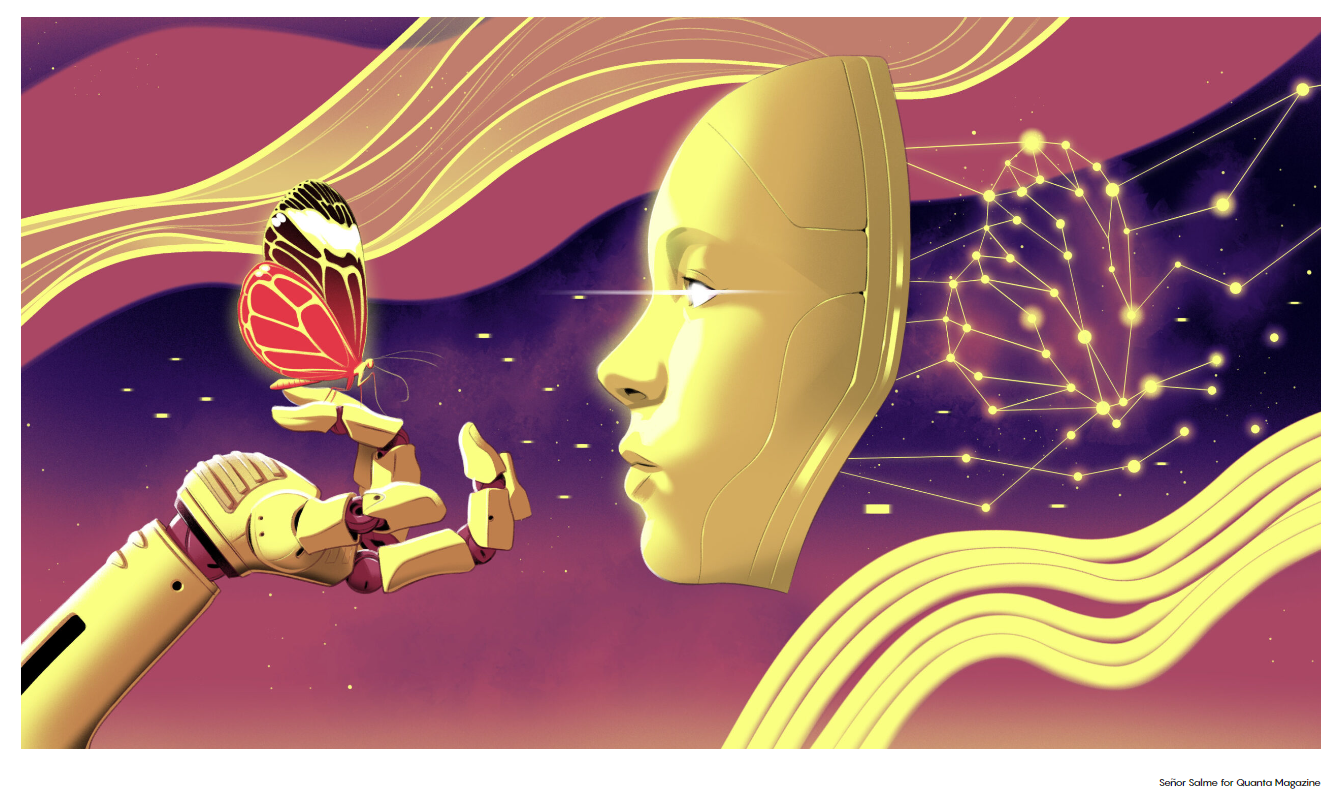
“For a decade now, many of the most impressive artificial intelligence systems have been taught using a huge inventory of labeled data. An image might be labeled ‘tabby cat’ or ‘tiger cat,’ for example, to ‘train’ an artificial neural network to correctly distinguish a tabby from a tiger. The strategy has been both spectacularly successful and woefully deficient.”
“Such ‘supervised’ training requires data laboriously labeled by humans, and the neural networks often take shortcuts, learning to associate the labels with minimal and sometimes superficial information. For example, a neural network might use the presence of grass to recognize a photo of a cow, because cows are typically photographed in fields.”
“‘We are raising a generation of algorithms that are like undergrads [who] didn’t come to class the whole semester and then the night before the final, they’re cramming,’ said Alexei Efros, a computer scientist at the University of California, Berkeley. ‘They don’t really learn the material, but they do well on the test.”’
“For researchers interested in the intersection of animal and machine intelligence, moreover, this ‘supervised learning’ might be limited in what it can reveal about biological brains. Animals — including humans — don’t use labeled data sets to learn. For the most part, they explore the environment on their own, and in doing so, they gain a rich and robust understanding of the world.”
“Now some computational neuroscientists have begun to explore neural networks that have been trained with little or no human-labeled data. These ‘self-supervised learning’ algorithms have proved enormously successful at modeling human language and, more recently, image recognition. In recent work, computational models of the mammalian visual and auditory systems built using self-supervised learning models have shown a closer correspondence to brain function than their supervised-learning counterparts. To some neuroscientists, it seems as if the artificial networks are beginning to reveal some of the actual methods our brains use to learn.”
Google’s Search AI Now Looks for General Consensus to Highlight More Trustworthy Results, by Mariella Moon
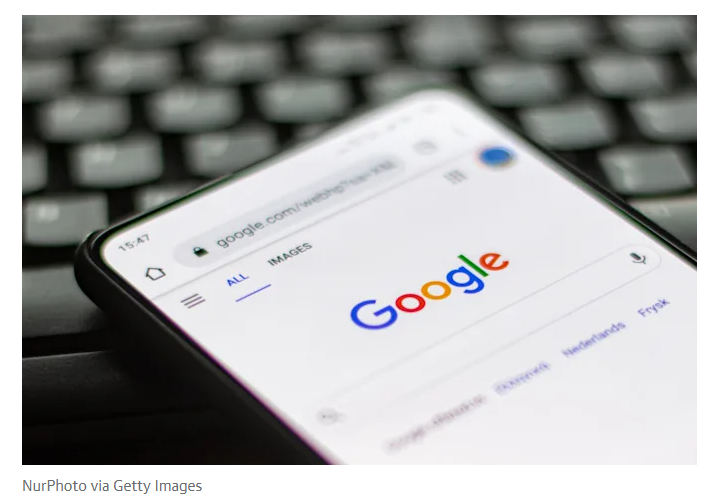
“You know that highlighted piece of text at the very top of a Google search results page when you look up a piece of information? That's called a ‘featured snippet,’ and it's meant to provide you with a quick answer to your query. Now, Google is making sure that the information it highlights is reliable and accurate by using its latest AI model, the Multitask Unified Model, so that Search can now look for consensus when deciding on a snippet to feature.”
“Google's Search AI can now check snippet callouts — those are the information with larger fonts that serve as heading for featured snippets — against other high-quality sources online. It can figure out if there's a general consensus for that callout, even if sources use different words or concepts to describe the same fact or idea. Google says this ‘consensus-based technique has meaningfully improved the quality and helpfulness of featured snippet callouts.”’
“But for some queries, such as those with false premises, displaying features snippets isn't the best way to deliver information. To address that issue, Google tweaked its Search AI so that this particular update reduces the triggering of snippets for those types of queries by 40 percent.”
“Google is now also making its ‘About this result’ tool more accessible. That's the panel that pops up when you click on the three dots next to a result, showing you details about the source website before you even visit. Starting later this year, it will be available in eight more languages, including Portuguese, French, Italian, German, Dutch, Spanish, Japanese and Indonesian. It's adding more information to the tool starting this week, as well, including how widely a publication is circulated, online reviews about a company, or whether a company is owned by another entity. They're all pieces of information that could help you decide whether a particular source is trustworthy.”
“Finally, in case Google's AI has determined that the overall results for a search query may have questionable quality, the results page will now display a content advisory. "It looks like there aren't many great results for this search," the advisory will say, telling you to check the source you're looking at or to try other search terms. It could help you stay alert and be on the lookout for potential fake information while checking the results the website had presented.”
In Simulation of How Water Freezes, Artificial Intelligence Breaks the Ice, by Princeton University
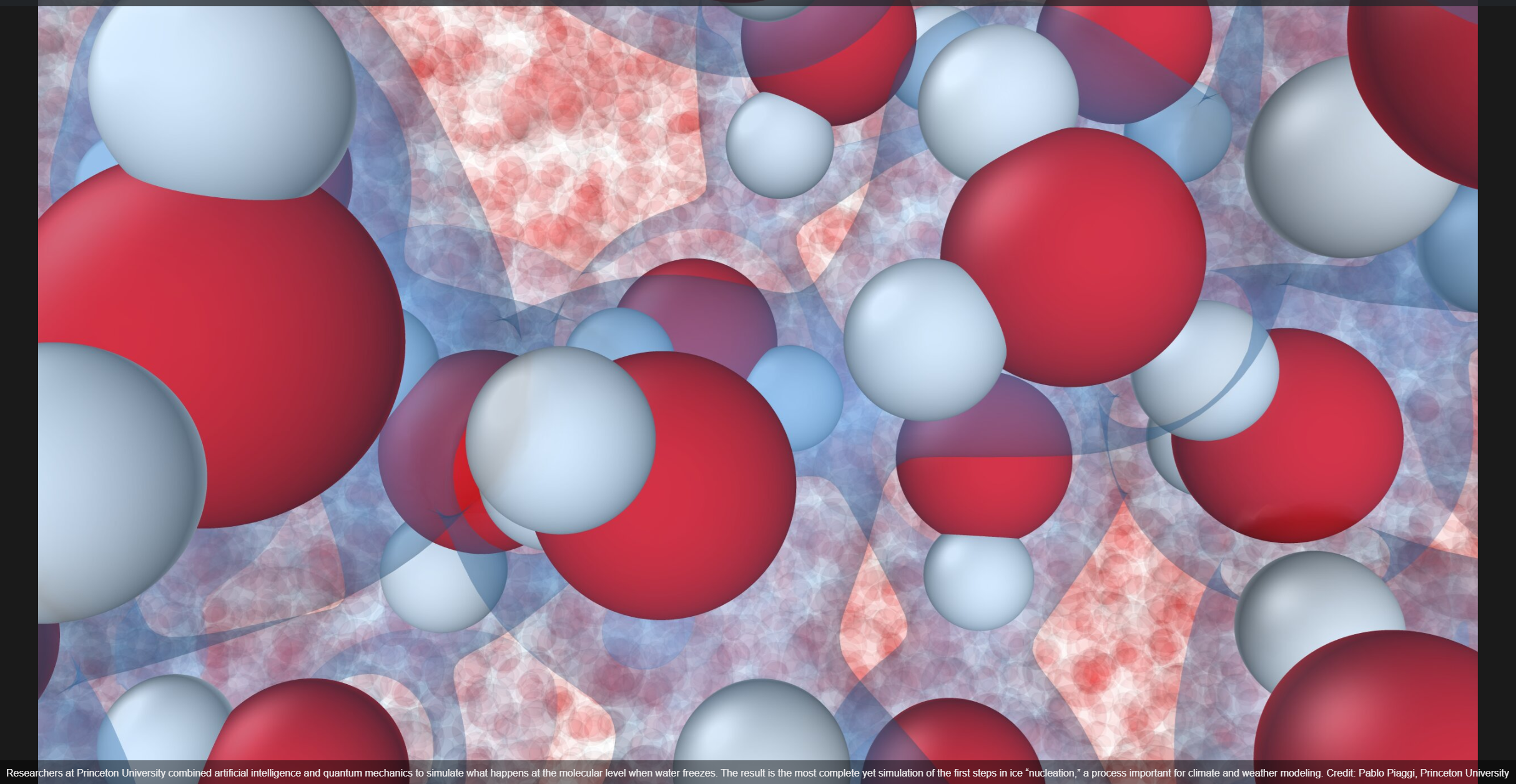
“A team based at Princeton University has accurately simulated the initial steps of ice formation by applying artificial intelligence (AI) to solving equations that govern the quantum behavior of individual atoms and molecules.”
“The resulting simulation describes how water molecules transition into solid ice with quantum accuracy. This level of accuracy, once thought unreachable due to the amount of computing power it would require, became possible when the researchers incorporated deep neural networks, a form of artificial intelligence, into their methods. The study was published in the journal Proceedings of the National Academy of Sciences.”
“‘In a sense, this is like a dream come true,’ said Roberto Car, Princeton's Ralph W. *31 Dornte Professor in Chemistry, who co-pioneered the approach of simulating molecular behaviors based on the underlying quantum laws more than 35 years ago. ‘Our hope then was that eventually we would be able to study systems like this one, but it was not possible without further conceptual development, and that development came via a completely different field, that of artificial intelligence and data science.”’
“The ability to model the initial steps in freezing water, a process called ice nucleation, could improve accuracy of weather and climate modeling as well as other processing like flash-freezing food.”