

BLOG
A Brief Tour of the PDP-11, the Most Influential Minicomputer of All Time, by Andrew Hudson

“The history of computing could arguably be divided into three eras: that of mainframes, minicomputers, and microcomputers. Minicomputers provided an important bridge between the first mainframes and the ubiquitous micros of today. This is the story of the PDP-11, the most influential and successful minicomputer ever.”
“The PDP-11 was introduced in 1970, a time when most computing was done on expensive GE, CDC, and IBM mainframes that few people had access to. There were no laptops, desktops, or personal computers. Programming was done by only a few companies, mostly in assembly, COBOL, and FORTRAN. Input was done on punched cards, and programs ran in non-interactive batch runs.”
“Although the first PDP-11 was modest, it laid the groundwork for an invasion of minicomputers that would make a new generation of computers more readily available, essentially creating a revolution in computing. The PDP-11 helped birth the UNIX operating system and the C programming language. It would also greatly influence the next generation of computer architectures. During the 22-year lifespan of the PDP-11—a tenure unheard of by today’s standards—more than 600,000 PDP-11s were sold.”
“…the PDP-11 helped popularize the interactive computing paradigm we take for granted today. If you’re looking for a single device that best represents the minicomputer lineage, the PDP-11 is it.”
How Is the Use of Virtual Reality in Architecture Becoming Increasingly More Significant?, by Jullia Joson

“The importance of the use of advanced technologies, such as the likes of virtual reality in the scene of architecture, is becoming increasingly necessary. No matter how beautiful a rendered image may be, it will always lack the capacity to fully convey the scope and feel of a project as a whole, further perpetuating the necessity to incorporate the use of these technologies at a professional practice level.”
“Architects who choose not to adopt the use of virtual reality technologies into their design process fall victim to being at a significant disadvantage, and the problem no longer even lies within accessibility, as VR is very much a possibility for architects of all backgrounds in the present age.”
“Head-mounted displays (HMDs) such as Oculus Rift, house the capacity to change how architects and designers create and communicate their ideas long before structures are actually even built. Clients can easily be transported into three-dimensional representations of the working design to further bring themselves into a state of immersion, almost akin to the emotions evoked when you engage within a virtual built environment within the likes of video games.”
“Virtual worlds aim to temporarily transport consumers to another reality, a well-constructed environment that can transmit subtle things, such as emotions, feelings, and sensations, therefore, if clients are able to experience the influx of those emotions prior to physically standing in the building, it opens opportunities for changes to be made before committing to a build.”
“The use of an immersive representation allows an opportunity for greater immediate understanding and comprehension of these design elements, as opposed to just looking at a scale model or visual render.”
Walmart Launches AI-Powered Virtual Clothing Try-On Technology for Online Shoppers, by Sarah Perez

“Last May, Walmart announced its acquisition of the virtual clothing try-on startup Zeekit, which leveraged a combination of real-time image processing, computer vision, deep learning and other AI technologies to show shoppers how they would look in an item by way of a simulation that takes into account body dimensions, fit, size and even the fabric of the garment itself. Today, Walmart says it’s bringing that technology to Walmart.com and its Walmart mobile app.”
“The retailer is introducing the computer vision neural network-powered “Choose My Model” try-on feature, now in beta, which will now allow Walmart customers to select a model that better matches their own appearance and body type. At launch, online shoppers will be able to choose from among 50 different models to find one who best reflects their own skin tone, height and body shape so they can get a better idea of how clothing would look on them.”
“During tests, Walmart said it received positive customer feedback about the experience, which it hopes will make online clothes shopping feel more like in-person shopping.”
How AI Could Help Bring a Sustainable Reckoning to Hydropower, by Anuradha Varanasi
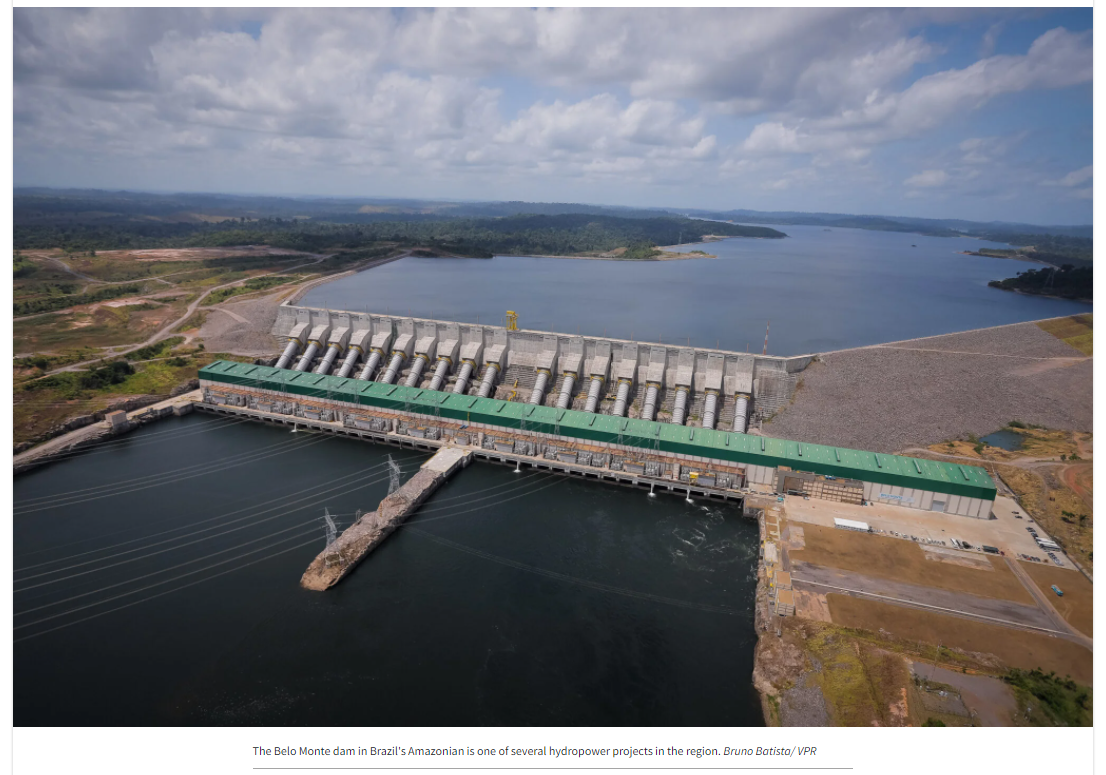
“Hydropower has been stirring up controversies since the early 2000s. Despite being promoted as a solution to mitigate climate change, the hydropower bubble burst when researchers discovered in 2005 that hydropower dams are responsible for huge amounts of greenhouse gas emissions.”
“Hydropower dams’ walls restrict the flow of rivers and turn them into pools of stagnant water. As these reservoirs age, organic matter like algal biomass and aquatic plants accumulates and eventually decomposes and sinks. That oxygen-poor environment stimulates methane production. “
“Reservoir surfaces and turbines then release methane into the atmosphere. Methane makes up approximately 80 percent of the greenhouse gases emitted from hydropower dams, peaking in the first decade of the dams lifecycle.”
“To identify environmentally-friendly sites for new hydropower dams, the 2019 team harnessed data from a sophisticated computational model that uses artificial intelligence (AI). They observed that lowland dams in Brazil (a predominantly lowland country) tend to have large reservoir areas which yield significantly higher carbon intensities. The Brazilian Amazon has the highest number of carbon-intensive dams as compared to the mountainous parts of Bolivia, Ecuador, and Peru. Higher elevation and steep topography, they found, make for less carbon-intensive hydropower.”
“In a recent study published in the journal Science last week, a team of researchers utilized AI to scale the Amazon basin. They found that uncoordinated hydropower expansion resulted in forgone ecosystem benefits. Additionally, effective dam arrangements in other locations could generate four times more power.”
“‘AI is being used by Wall Street, by social media, for all kinds of purposes – why not use AI to tackle serious problems like sustainability?’ study author Carla Gomes, a computer scientist at Cornell University, said in a press release.”
Artificial Intelligence to Help Farmers See Cloud-Covered Fields, by Jonathan Amos
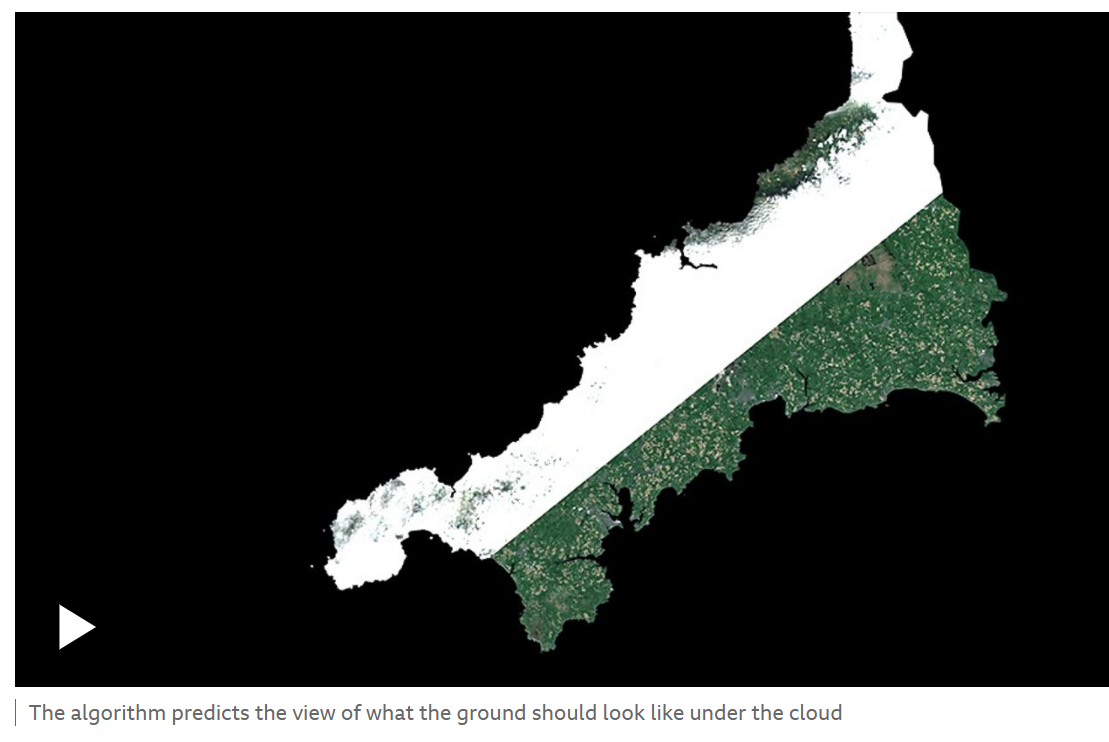
“A Cornish start-up has developed a technique using artificial intelligence to predict what the surface of the UK looks like under gloomy skies.”
“Aspia Space's technology can produce a clear synthetic image of fields in all weathers.”
“This means that for a farmer wanting to assess their crop performance this year, instead of getting just a handful of cloud-free Sentinel-2 pictures of their fields through the growing season, they can now have a Sentinel-2-like image every time the radar satellite comes overhead.”
“Aspia's Jim Geach says the reactions he's had so far have been very encouraging, and believes the algorithm will open up the six-year archive of cloudy Sentinel-2 imagery to all kinds of new analysis, from mapping trends in drought to tracking the extent of frost and snow cover.”
“‘We have a way of identifying flood risk at a highly granular scale, because you can go back through the entire archive and ask: What fraction of time was a given pixel ever saturated by water? And, of course, that's a map that's going to be changing over time as the climate changes,’ he explained.”
Virtual Reality Increasingly Used to Convey Climate Urgency, by Mark Albert
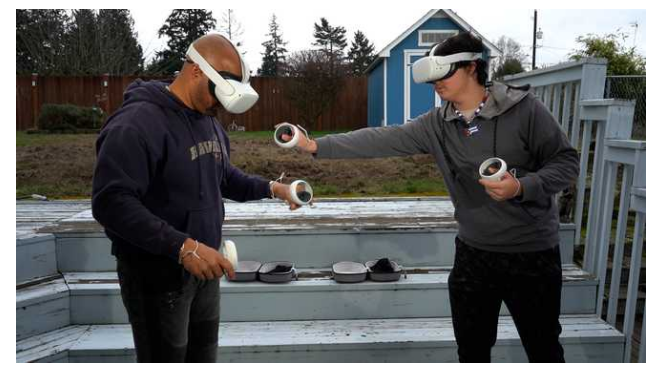
“Just like checking out a book, families can check out projections of a changing climate in their own home. Program organizers hope to begin the individual check-out process once the pandemic subsides. The goal is to convey climate research through a visceral experience that transcends generations and backgrounds. Researchers hope it will be life-changing.”
“‘I didn't realize it was possible for the sea level to rise that much,’ Mateo said in an interview afterward. ‘Like, it was at our waist, where normally it wouldn't even be at our feet. And I think that's kind of crazy.”’
“‘With the VR headsets, ‘you relate more to it and then you're going to really care more about climate change,’ Rubio said. ‘It's more live, it's less dry.”’
“‘We know we're already living the negative consequences of a warmer world,’ Roop explained, ‘but how bad it gets and what future we have to live in – that is up to us.”’
Could Artificial Intelligence Really Wipe Out Humanity?, by Jona Jaupi
“Despite Musk’s prediction, most experts in the field say humanity has nothing to worry about when it comes to AI – at least, not yet.”
“In order for AI to achieve this, it would not only need to possess human-like intelligence, but it would also need to be able to predict the future or plan ahead.”
“‘Machine learning and AI systems are a long way from cracking the hard problem of consciousness and being able to generate their own goals contrary to their programming,’ George Montanez, a data scientist at Microsoft, wrote under the same Metafact thread.”’
“Some experts even go as far as to say that not only is AI not a threat to mankind, but could help us to better understand ourselves.”
“That said, it is clear that AI (and any technology) could pose a risk to humans.”
“Some of these risks include overoptimization, weaponization, and ecological collapse, according to Ben Nye, the Director of Learning Sciences at the University of Southern California, Institute for Creative Technologies (USC-ICT).”
Why You Can’t Have Legs in Virtual Reality (Yet), by Rachel Metz

“Today, if you gallivant around Meta's flagship social VR app, Horizon Worlds, you do so without legs or feet. While you can customize your avatar to look somewhat like you, it will still have the ghostly appearance of a floating torso with only a head, arms, and hands.”
“The difference between the realistically responsive full-body avatar Zuckerberg imagines and the typical options currently available in VR apps is more than just aesthetic.”
“Companies can track a person's upper body reasonably well with a headset and controllers, but actual leg tracking is practically non-existent in virtual reality right now — at least when it comes to the kind of VR you're likely to use in your living room. Some apps, such as VRChat, do let people have full-body avatars, but they tend to use software to approximate lower-body motions; it can be silly-looking at best and disconcerting (or even sickening) at worst.”
“If a company wants to represent a person's legs in a realistic way in VR, it needs to find a way to keep tabs on what those legs are actually doing in real life. Adding more sensors to the headset itself — like cameras on the underside that point toward the ground — might seem like a potential solution, but, as Bar-Zeev said, it's not that easy.”
“Daniel O'Brien, general manager of HTC America, said that over time he expects the ability to track more points on the body, such as feet and hips. ‘I think full body immersion and tracking with an all-in-one headset is what everybody wants and everybody is working toward,’ O'Brien said, though like Meta's Bosworth he cautioned that it's just not possible right now.”’
“West suggests that leg movements may eventually be animated with the help of AI: Motion could be predicted based on data from the headset about how a person's head is moving. However, doing this well would require a massive amount of data about the ways people walk, for instance, and since it would not include tracking the legs specifically, it wouldn't be true to how each person moves. (Meta already uses AI along with sensors to track headsets, controllers, and hands.)”
DeepMind Has Trained an AI to Control Nuclear Fusion, by Amit Katwala
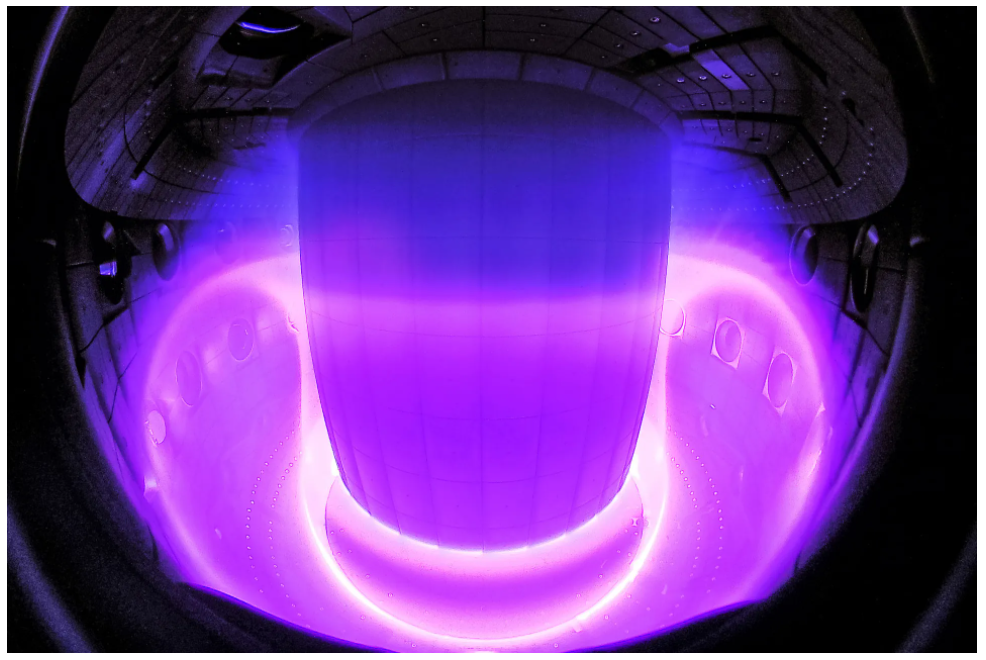
“The inside of a tokamak—the doughnut-shaped vessel designed to contain a nuclear fusion reaction—presents a special kind of chaos. Hydrogen atoms are smashed together at unfathomably high temperatures, creating a whirling, roiling plasma that’s hotter than the surface of the sun. Finding smart ways to control and confine that plasma will be key to unlocking the potential of nuclear fusion, which has been mooted as the clean energy source of the future for decades.”
“That’s where DeepMind comes in. The artificial intelligence firm, backed by Google parent company Alphabet, has previously turned its hand to video games and protein folding, and has been working on a joint research project with the Swiss Plasma Center to develop an AI for controlling a nuclear fusion reaction.”
“DeepMind has developed an AI that can control the plasma autonomously. A paper published in the journal Nature describes how researchers from the two groups taught a deep reinforcement learning system to control the 19 magnetic coils inside TCV, the variable-configuration tokamak at the Swiss Plasma Center, which is used to carry out research that will inform the design of bigger fusion reactors in the future. ‘AI, and specifically reinforcement learning, is particularly well suited to the complex problems presented by controlling plasma in a tokamak,’ says Martin Riedmiller, control team lead at DeepMind.”’
“The neural network—a type of AI setup designed to mimic the architecture of the human brain—was initially trained in a simulation.”
“Ultimately, Fasoli says, the collaboration with DeepMind could allow researchers to push the boundaries and accelerate the long journey toward fusion power. ‘AI would enable us to explore things that we wouldn’t explore otherwise, because we can take risks with this kind of control system we wouldn’t dare take otherwise,’ he says. ‘If we are sure that we have a control system that can take us close to the limit but not beyond the limit, we can actually explore possibilities that wouldn’t otherwise be there for exploring.”’
Important Milestone Reached in Quantum Computing With Error Correction, by Delft University of Technology

“Researchers at QuTech—a collaboration between the TU Delft and TNO—have reached a milestone in quantum error correction. They have integrated high-fidelity operations on encoded quantum data with a scalable scheme for repeated data stabilization. The researchers report their findings in the December issue of Nature Physics.”
“‘Two capabilities will distinguish an error corrected quantum computer from present-day noisy intermediate-scale quantum (NISQ) processors’, says Prof Leonardo DiCarlo of QuTech. ‘First, it will process quantum information encoded in logical qubits rather than in physical qubits (each logical qubit consisting of many physical qubits). Second, it will use quantum parity checks interleaved with computation steps to identify and correct errors occurring in the physical qubits, safeguarding the encoded information as it is being processed.’ According to theory, the logical error rate can be exponentially suppressed provided that the incidence of physical errors is below a threshold and the circuits for logical operations and stabilization are fault tolerant.”
“The basic idea thus is that if you increase the redundancy and use more and more qubits to encode data, the net error goes down. The researchers at TU Delft, together with colleagues at TNO, have now realized a major step toward this goal, realizing a logical qubit consisting of seven physical qubits (superconducting transmons). ‘We show that we can do all the operations required for computation with the encoded information. This integration of high-fidelity logical operations with a scalable scheme for repeated stabilization is a key step in quantum error correction’, says Prof Barbara Terhal, also of QuTech.”